
Why Kshama Lost
Gwendolyn Hart & Em Smith
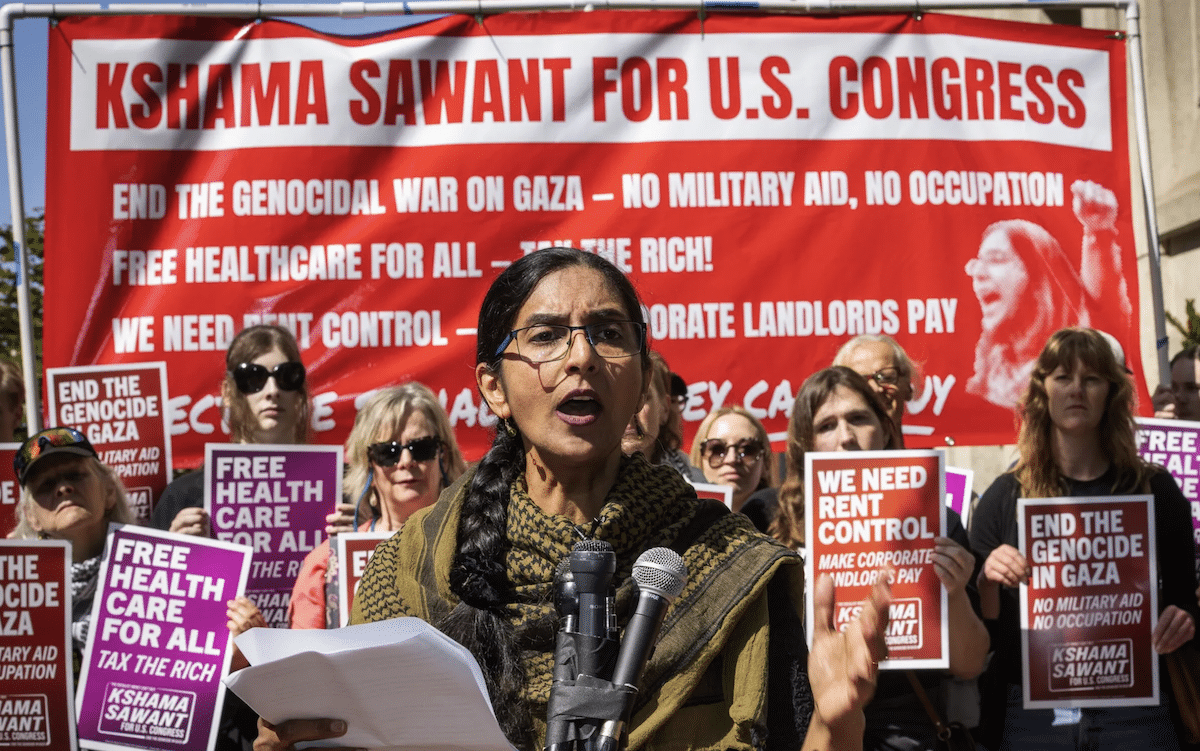
In the August 4th primary elections in Washington state, 25,000 votes were cast for Kshama Sawant, who ran as an independent socialist in Washington’s 9th Congressional district.
Sawant won 17.3 percent of the vote, placing third in a five-way race behind 30-year incumbent Democrat Adam Smith and Republican Doug Basler. A distant fourth and fifth place went to “progressive” Democrat Melissa Chaudhry, and fake socialist Jacob Perasso with the Zionist Socialist Workers Party, who won an appropriate 1 percent of the vote.
So what can we learn from Sawant’s election results?
One thing is clear: the rich don’t like socialism, and they don’t like Sawant. She bombed in the wealthy enclaves of Mercer Island and Beaux Arts Village, a private lakeside community with a median home value of over $2 million, where she got 6 percent of the vote. She fared only a little better in the business center of Bellevue, at 9 percent. She also did poorly in outer suburbs like Federal Way (10 percent), Auburn (10 percent), and Des Moines (11 percent), which aren’t rich but are far from Sawant’s historic base of support in Seattle.
Sawant did better in nearer suburbs like Kent (13 percent), Renton (15 percent), and Tukwila (20 percent). In Seattle itself, she got 35 percent of the vote and defeated Smith in about half of precincts. She performed best in areas with high numbers of renters and immigrants. But she did poorly in black working-class neighborhoods like Rainier Beach and Dunlap, where there was low voter turnout and Sawant often got only 20-25 percent of the vote.
Since her loss, Sawant has been beating her chest, calling her campaign “by far the strongest ever by an openly Marxist candidate for U.S. Congress." That’s partly true. Sawant’s 17.3 percent vote share is higher than any self-described Marxist congressional candidate since the 1890s. But like with most of her victories ($15, the Amazon Tax, etc.), Sawant’s chest-beating hides the shortcomings of the campaign. Sawant’s “victory” is diminished by the fact that she doesn’t have a party, and her campaign did nothing to build one.
The entire point of a Marxist election campaign should be to strengthen the independent organization of the working class. Sawant repeatedly failed to use her campaign in this way. She ignored appeals from other groups to build joint campaigns, including a united front against ICE in Seattle. She failed to use her campaign to bridge any divisions on the left or build any roots in the unions. And her own organization, Revolutionary Workers, came out of the campaign smaller and weaker than when it started.
Still, 25,000 votes is a significant result, especially in the context of the obstacles arrayed against the campaign. Not only was it up against the Democratic and Republican parties, but also opposition from the leadership of DSA, the union bureaucracy, and the progressive media sphere which blocked coverage for the campaign.
In the end, Sawant fell 6,000 votes short of advancing to the general election. Why did she lose? Could the gap have been closed?
Abstention and Hostility on the Left
United Front for a Workers’ Party gave critical support to Sawant’s campaign despite sharp political disagreements with her and her organization, Revolutionary Workers. Our members spent hundreds of hours campaigning for her on the ground, despite public attacks on us from Sawant herself. And we put out a call to the other socialist organizations in Seattle to do the same.
But our call was only answered by a handful of organizations — Seattle Revolutionary Socialists, International Socialist Alternative (Revolutionary), and the Spartacist League. The vast majority of “revolutionary” organizations in Seattle decided to sit this election out.
Socialist Alternative (SAlt) counted Kshama as a member for fifteen years, including the decade she was elected to the Seattle City Council. They built their brand off of Sawant’s success. But in 2024, there was a split, and when Sawant announced her run for Congress, they refused to acknowledge even the existence of the campaign (astonishingly, even in articles where they reference Kshama’s history with their organization). When United Front for a Workers’ Party contacted them to discuss critically supporting the campaign, their leadership refused to respond.
They did in the end write an endorsement letter for Kshama, mere days before the election. It was a cynical maneuver to avoid their "bad behavior" being put on the record, so they slipped it in right under the deadline like late homework. This purely paper endorsement wasn’t even published on their website; they didn’t even knock a single door for this election.
The Revolutionary Communists of America (RCA), one of the largest socialist organizations in Seattle, also ignored Kshama’s campaign. In early months, the RCA leadership told the campaign they would take a wait and see approach to support. They finally published an endorsement three weeks before the election, the better part of a year later — and theirs mostly talks about how you should join the RCA. They did go further than SAlt (a low bar), in that around ten of their 70 members in Seattle did canvass for Kshama, but it was a meagre effort at the final hour.
Neither the RCA nor the SAlt endorsement had anything critical to say about Sawant, or any explanation for why they were silent for the first 14 months of the campaign.
Many other small organizations such as FRSO told their members to vote for Kshama in private, but in public ignored the campaign. This is despite the fact one of FRSO’s main focuses in Seattle is protesting against Adam Smith personally for being such a genocidal imperialist. This is sectarian and cowardly behaviour that disorganizes the working class.
Organizations like SAlt, RCA, and FRSO — and most of the Marxist left — routinely refuse to support anything led by other organizations. They remain fixated on slowly growing their tiny spheres of influence, convinced that they’re the ones who will become the one true revolutionary party (the RCA insists they already are). The calculation these organizations have made is that they would rather keep a capitalist in power than risk another socialist organization getting credit.
This brings us to the big socialist organization in the U.S., the DSA, which now counts over 130,000 members.
The local DSA leadership initially tried to block even a discussion on endorsing Sawant’s campaign. They tried to justify this political maneuver with procedural nonsense. Rank-and-file DSA members forced a vote on opening the endorsement process, but it ultimately failed by 25 votes after the leadership came out strongly against it.
The Seattle DSA chapter has 2,000 members. Mobilizing this force alone could have tipped the balance in this election. Instead, the chapter ignored it and has been holding weekly canvassing shifts for a Democrat who is running unopposed.
Seattle DSA had previously endorsed Sawant in multiple campaigns for City Council, in 2019 and 2021. But since then, the contradictions within DSA have grown to massive proportions. After Biden took office in 2021, DSA’s “socialists” in office carried out major public betrayals — AOC’s vote to break a railroad strike, her support for the Biden-Harris administration’s policy of genocide, etc. In DSA’s eyes, Kshama made the “mistake” of publicly criticizing AOC and Mamdani for their betrayals. The DSA leadership couldn’t abide someone who exposes DSA’s opportunistic ties to the Democratic Party gaining a national platform in Congress.
How Could DSA’s Opportunist Leadership Have Been Overcome?
Kshama has been a member of DSA since 2021. Since then, she has thrown rocks at AOC, Mamdani, and the rest of the DSA leadership (good!), but she has done it at a safe distance, entirely removed from DSA itself. She has refused to put up a real fight inside DSA and try to create a pole of attraction for its members who want to split from the Democratic Party.
DSA has 130,000 members. It can’t be ignored, and its feckless leadership can’t just be a punching bag to deflect from the left’s failures. Opportunists will be opportunists. The challenge for the left is how to defeat them. Kshama Sawant failed, and we should learn from her failure.
Sawant’s organizations, first Socialist Alternative and then Revolutionary Workers, pursued a half-baked strategy in DSA. In 2020, Socialist Alternative publicly sent its members into DSA to “fight” for revolutionary politics, but only a small handful of members ever actually joined. There was never any fight. They proposed a couple resolutions, failed to get them passed, and by 2023, the organization had quietly abandoned the tactic. Sawant and a handful of others maintained their membership on paper, but only on paper.
This “half in, half out” approach has been a disaster. It has shielded DSA leadership from a real internal challenge, while feeding the accusations that Sawant is using DSA membership opportunistically. Those attacks have landed, because they’re true.
Sawant didn’t even mobilize for her own endorsement vote in DSA. That vote failed by only 25 votes. Members of Labor Militant and ISA-R were there to support the endorsement, but Sawant’s organization, Revolutionary Workers (RW), brought only five people, if you include Kshama’s disembodied voice over Zoom. RW has about 25 members in Seattle. That alone could have almost tipped the balance and won the vote, not to mention the 200+ members of Workers Strike Back in Seattle. In the end, Sawant lost the DSA endorsement because she didn’t even try.
It didn’t have to be this way. When Socialist Alternative joined DSA in 2020, it had 155 members in Seattle. If SAlt had actually committed to organizing themselves as a force inside DSA and using the platform of Sawant’s council office, they could have waged a serious fight for revolutionary leadership. Of course, this would have been intolerable for the national DSA leadership. But it would have heightened the contradictions within the organization, exposed the opportunists, and helped to bring together a militant wing.
The cracks in DSA are being exposed. In 2023, the Rhode Island DSA banned the endorsement of Democratic Party politicians, creating a split in their chapter. Small chapters like Akron DSA and Mahoning Valley DSA have endorsed independent socialists like Greg Levy, drawing denunciations from the right wing of DSA. Labor Militant, ISA-R, and the Just Break Already caucuses recently launched a United Front for a Clean Break, calling for complete independence from the Democratic Party and the expulsion of DSA Democrats like AOC and Mamdani.
SAlt, RW, and Sawant could have played a major role in strengthening this “clean break” wing of DSA. Instead, they have basically abstained.
After failing to move it from the outside, Sawant’s approach to the DSA has turned bitterly sectarian. In September of last year, Seattle DSA was finalizing a plan for a ballot initiative campaign for free childcare in the city. Sawant and RW refused to support it, on the basis that it would be “under the control of DSA.” This is textbook sectarianism, but it was also incredibly stupid. Supporting this ballot initiative would have strengthened Sawant’s Congressional campaign by showing that she was fighting for real material benefits for working-class people. It also would have undermined the arguments of DSA leadership that she doesn’t play nice with other socialists.
This campaign for free childcare, which was popular even within DSA, was later killed by a faction of the DSA leadership, acting under pressure from the union bureaucracy. SEIU leaders opposed it, using the ludicrous claim that it would be “unfair” for families in Seattle to have free childcare, while others in Washington state don’t. The DSA leadership faction fear-mongered that opposition from SEIU would be “impossible” to overcome, and they narrowly won a vote to shut down the campaign. Sawant’s campaign could have been decisive in overcoming this opposition. Instead, they refused to support an effort that was in the clear interest of workers (and their own campaign).
Sectarianism Towards the Left
Sawant’s abstention from DSA could almost be forgiven. It’s a mess of bureaucratism, opportunism, and ultraleftism, in service of the Democratic Party. It’s not a fun place for a Marxist to be.
But Sawant didn’t just isolate herself from DSA. She isolated herself from Marxists who wanted to support her campaign. And in the final months of her campaign, she actively fought against the kind of united front that could have helped her win.
In late January, Sawant fired four campaign workers — the campaign manager, the field team lead, and two field team staff — for raising political disagreements. The leadership tried to suppress those disagreements. When that failed, they tried to channel them into a character assassination campaign against a staff member, Summer Miller. Summer had been the first to raise disagreements with the direction of the campaign. As a reward, she faced vicious personal attacks, including accusations of mental illness from Sawant and other members of the leadership.
When members refused to drop their disagreements or throw a comrade under the bus, the leadership escalated. Summer Miller and campaign manager Em Smith were undemocratically suspended. Eight leading members of Revolutionary Workers signed a letter to protest these suspensions, but they were immediately met with threats and ultimatums to remove their names. In the end, five gave into the pressure and removed their names. The other three quit RW in protest and helped launch a new organization, Labor Militant.
From the beginning of this split, we made it clear that we wanted to work together to build Kshama’s campaign, despite our differences. Instead, the campaign leadership continued to escalate. They banned Labor Militant members from attending campaign events or volunteer shifts. Then they called an emergency closed-door meeting to undemocratically remove Em Smith from an elected leadership position in Workers Strike Back. To this day, Workers Strike Back members have not been notified that Em was removed from her elected position.
Blocked from working directly with the campaign, we launched an independent effort called “Movement for Kshama.” We brought in multiple organizations — Seattle Revolutionary Socialists, ISA-R, and the Spartacist League — to table, doorknock, phonebank, and poster in support of Kshama’s campaign. Sawant and the campaign responded by publicly attacking us, suggesting that we may be Democratic Party wreckers in disguise. The campaign refused invitations to speak at our events, including the inaugural meeting of United Front for a Workers’ Party, which featured independent socialists running across the country. Comically, they even sent us a silly “cease and desist” letter after the election ended claiming United Front does not have the “legal right” to use Kshama’s image on posters supporting her in the election.
There is a wall of sectarianism which Kshama and most other left “leaders” have erected around their organizations, which only serves to fragment and disorganize the working class. For Kshama, the consequence of this sectarianism was a deadly weakening of her own campaign. She refused to tolerate disagreement within her organization, which led her to push out five of the most active and dedicated members of her organization (one-sixth of the entire membership). She chopped off an arm because it was pointing out the rot in the rest of the body.
Kshama also failed the basic test of a Marxist campaign: using the campaign to build the class struggle. She ignored appeals from Labor Militant and United Front for a Workers’ Party to build a fight against ICE in Seattle. She abandoned a public pledge to fight for renters’ rights in Federal Way. During the campaign, she began to walk away from her pledge to lead a ballot initiative campaign for free healthcare in Seattle that hundreds of Workers Strike Back members voted to carry out, a pledge that she has now entirely abandoned. She refused to support any other independent socialist election campaign around the country, outside of a single tweet in support of Andre Easton in New York. Increasingly, her attention was consumed by the narrow task of counting votes.
It’s a very good thing that Sawant’s campaign got 25,000 votes. It tells us a lot about the potential for Marxism in Seattle. But votes by themselves don’t do anything to build the socialist movement.
Ultimately, a campaign is only as good as its leaders. The same is true of any movement. Kshama demonstrated — not by the loss of her campaign, but by the nature of her mistakes — that she is not the leader we need.
Who Killed Kshama’s Campaign?
Any good autopsy needs a clear cause of death. For Kshama’s congressional campaign, the only scientific conclusion is that it was a murder-suicide.
There were three perpetrators: the opportunists in DSA and the union bureaucracy, who refused to support her campaign; the sectarians on the left who ignored it; and Kshama Sawant herself, who sabotaged it every step of the way. The “left” did the dirty work. All Adam Smith and the Democrats had to do was collect the insurance money.
This election was a lesson for the socialist left, because it’s an illustrative microcosm of all the sectarian and opportunist dead ends that need to be overcome if we want to have an effective Marxist movement in this country.
In particular, the splintering and self-isolation of the left has been a disaster. Every day, a hundred tiny Marxist organizations are explaining to their members why the other 99 are wrong. But most of the time, these conversations happen in private, out of sight of the broader movement, where they can’t be challenged or tested.
Marx said in 1845, “The fight over whether an idea is true or untrue which is isolated from practice is a purely scholastic question.” Lenin put it more simply: “the truth is always concrete.”
To most workers the differences between Marxist organizations are so minute they are hardly distinguishable. To give those differences meaning, they need to be debated where workers can see them. What we need is to come together into a common organization where we can unite around common campaigns and publicly debate our ideas in full view of the working class.
We hope Kshama Sawant is willing to correct her mistakes and will join us to begin serious efforts to build a revolutionary working-class party.