
Open Letter to Socialists: We Need a United Front
A proposal for joint organization
Em Smith
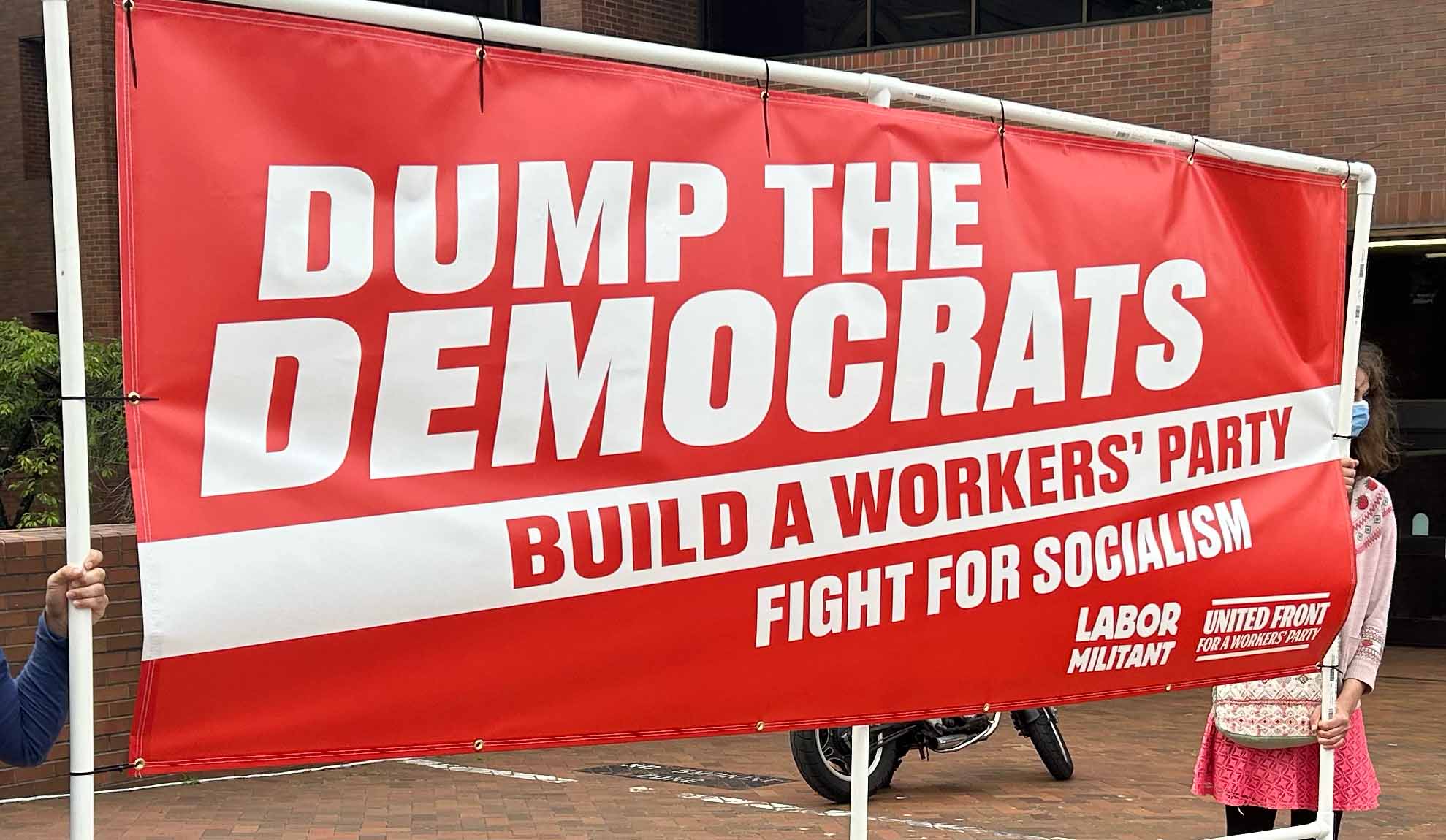
It is no secret that the socialist movement is in crisis. The Marxist left is weaker and more splintered than ever before.
Decades of splits and purges have left us fragmented and isolated from each other. We are divided into a thousand tiny sects, each of whom think that their organization will be the one.
But no group on the left has been able to present a serious challenge to the opportunistic “socialists” running inside the capitalist Democratic Party (AOC, Mamdani, etc.), who are doing their best to drive workers back into the arms of Hakeem Jeffries and the Democrats.
Sharp debate is needed among Marxists — on imperialism, on the class character of China, on work in the DSA, on a Marxist approach to elections, on the question of critical support and the united front, etc.
But at the moment, those debates are being held in a vacuum where very few workers can see them, much less understand them and make their own judgments. For the most part, Marxists do their work in isolation from each other. When they do debate, it is in the abstract, confined to the pages of disparate newspapers, which are read by a tiny fraction of the socialist movement, and an even tinier section of the working class. Even more often, “debates” are confined to small internal meetings, where members of an organization are “taught” why another organization or tendency is wrong.
In order for debate to be meaningful, it needs to be open. It also needs to be concrete and connected to practical work. As Lenin said, the truth is concrete — and the test of theory is in action.
In our view, achieving maximum clarity today is only possible if Marxists pursue joint work and a common organization.
Back to the Beginning
In 1901, Lenin wrote Where to Begin to address the fragmentation of the Social Democratic movement in Russia: “Our movement suffers in the first place, ideologically, as well as in practical and organisational respects, from its state of fragmentation …. It is precisely in this state of fragmentation that one must look for the deepest roots of the instability and the waverings noted above.”
The situation today is not so different. There are at least three dozen self-described Marxist organizations in the United States today with a presence in multiple cities. Within the same city, there are often at least half a dozen Marxist organizations — in large cities, the number is higher. In some cases, the combined membership of these organizations is larger than the active membership of DSA. Marxists are punching below our weight, and our fragmentation is holding us back. The question is screaming louder: what are we even accomplishing?
How do we overcome the fragmentation of our movement? Lenin’s solution was a newspaper, which would act as a collective organizer for the movement, bind local organizations together, collectivize the experience of local work, and allow space for debate and polemics.
Of course, the last thing the U.S. left needs is another paper. The only way to unite the movement today is by striving to rebuild a common organization.
No More Arrogance
Each organization on the left thinks that their ideas, their methods, their perspectives are the correct ones. Many see themselves as the singular continuation of revolutionary thought — stretching in an “unbroken thread” from Lenin and the Bolsheviks to today.
This idea is occasionally reinforced by a rapid growth of membership. Every few years in recent decades, at least one organization has had their moment in the sun. In the early 2010s, it was the International Socialist Organization; in the second part of that decade, it was Socialist Alternative; today, it is the Revolutionary Communists of America and the Party for Socialism and Liberation.
Every time, the train hits a wall. The ISO faced a spectacular collapse in 2019. Socialist Alternative entered a much more prolonged death spiral in 2024. Fractures are already showing in the RCA and PSL.
What comes from these disasters? Not a stronger left, but an archipelago of embittered, confused, and demoralized activists, who in the best cases regroup into much smaller organizations and are able to draw only partial lessons from their painful experience. In the worst cases, would-be revolutionaries drop out of the movement or dive head first into the opportunist swamp.
When an isolated and sectarian organization grows to a certain size, the weaknesses of the organization become clear. The organization fractures. It divides against itself. All of its weaknesses, previously hidden by its success, become magnified. Democratic centralism becomes a tool to enforce a unity that doesn’t exist, and to suppress the sharpest expressions of disagreement. Finally, the organization collapses. It collapses because it doesn’t know how to change leadership or correct course. It built itself in isolation, convincing its members that its leadership was uniquely positioned to build the revolutionary party. When the leadership fails, there is nothing to replace it.
Some on the left watch this collapse with joy, hoping that their organization will be next, sure that they will succeed where others failed.
This arrogance of the Marxist left is born out of sectarianism and isolation. Instead of arrogance, we need to build confidence in our ideas. Marxists should be confident enough to fight for our ideas within a broader organization, and to put those ideas to the test.
United Front for a Workers’ Party
We need to break the independent Marxist left out of its isolation.
DSA has grown to nearly 130,000 members. Self-described socialists have been elected at every level around the country, including the mayor of the largest city. Socialism is more popular than ever. Why has the Marxist left been unable to provide an answer? Why does the collective membership of Marxist organizations still number in the thousands, and not the tens of thousands?
DSA has succeeded, in part, because of its “big tent” and low barrier to entry. Socialists can join DSA without having a fully-formed opinion on the class character of China, on guerilla tactics in Latin America, or on any number of questions that have caused endless splits in the socialist movement.
But this is also DSA’s failure. It is a formless organization based on class collaboration, not working-class independence. With Mamdani’s betrayals and a possible presidential campaign from AOC, it is headed for a cliff.
Marxists need an answer to both the opportunism of DSA and the sectarian mess on the left.
In the first issue of Iskra in September 1900, Lenin explained, “the ideological unity of Russian Social-Democrats has still to be created, and to this end it is, in our opinion, necessary to have an open and all-embracing discussion of the fundamental questions of principle and tactics …. Before we can unite, and in order that we may unite, we must first of all draw firm and definite lines of demarcation. Otherwise, our unity will be purely fictitious, it will conceal the prevailing confusion and binder its radical elimination.”
In our view, Marxists need a common organization where we can debate and pursue common action. But to be useful, this organization needs to draw “firm and definite lines of demarcation” — against the capitalist Democratic Party, against the trade union bureaucracy, against U.S. imperialism, against the various forms of oppression, against sectarianism and opportunism, and for revolutionary leadership.
We need an organization which explicitly encourages debate, allows the development of groupings and factions, builds real democratic structures, engages actively in the class struggle, and takes real steps towards the development of a revolutionary workers’ party.
We launched United Front for a Workers’ Party to begin building such an organization. We have drafted Points of Unity, which we think reflect the key “lines of demarcation” — a minimum standard for membership — which is needed to break down sectarian barriers in a principled way, while still allowing for debate on key questions.
Marxists should not be afraid to build a common organization. It will not obscure our differences; on the contrary, it will bring them into sharper contrast. It will allow us to test our ideas against each other and allow workers to see these debates play out in practice, while at the same time building principled unity where we agree, and helping us punch above our weight in every struggle.
What we are proposing is a united front in organizational form, allowing each organization to maintain their independence and fight for their ideas, while building an organization in common. As Trotsky said, “We participate in the united front; but not for a moment do we dissolve in it. We take part in it as an independent unit. For it is in the struggle that the broad masses will convince themselves that we fight better than others; they will see that we fight with more determination, self-consciousness and cleverness. In this manner we accelerate the formation of the united revolutionary front under an undisputed Communist leadership.”
If you agree, we appeal to you to join United Front for a Workers’ Party. We urge Marxist organizations who have basic agreement with the Points of Unity to begin discussing affiliation. In the coming weeks, we will be hosting a series of public discussions on the Points of Unity, on the conditions and process for membership, and on building democratic and leadership structures.
Please reach out to foraworkersparty@gmail.com or message Em Smith at 208-284-7567 to discuss the draft Points of Unity and how we can build a revolutionary united front, and take real steps towards a workers’ party.