
Nationwide Teachers’ Strike in Mexico
Gwendolyn Hart
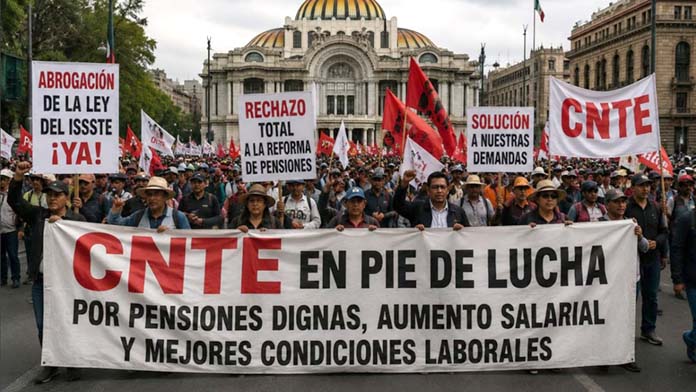
In June, Mexican teachers organized with the National Coordinator of Education Workers (CNTE) held a nationwide strike for twenty days during the FIFA World Cup. It started when the Mexican government refused to give teachers anything more than a 4 percent pay increase (barely covering inflation).
The teachers’ main demands were a 100% pay raise and restoring teacher pensions. In 2007, the Mexican government raised the retirement age and replaced pensions with private retirement accounts that pay retirees only 30% of their former salary.
Restoring pensions was a demand that Mexico’s current President Claudia Sheinbaum ran on during her election. As did her predecessor Lopez Obrador. But they both left this promise unfulfilled. Sheinbaum and Obrador are Morenistas, members of Mexico’s dominant left-wing party. They ostensibly position themselves as pro-welfare reformers but in practice sell workers out. It’s a party of AOCs and Mamdanis that rejects socialism and argues for a “better” capitalism.
The teachers in the CNTE called for a national strike on June 1 to take advantage of the leverage presented by FIFA. 88,546 teachers and 17,471 schools went on strike. Actions were held in over twenty of Mexico’s 31 states. 16,000 teachers from across the country travelled to Mexico City to set up an encampment in the Plaza de la Constitución and around the stadiums.
Teachers set up encampments all across the country. They occupied streets, highways, railways, toll booths, and the offices of the Ministry of Education. In many places they had to defend themselves against police violence. In the capital, police attacked teachers with tear gas and rubber bullets. In San Pablo Villa de Mitla, the police acting under a Morenista mayor attacked teachers with live ammunition, sending 15 to the hospital. But despite the repression, the government was not able to crush the strike.
The teachers could conduct a powerful strike because the CNTE is a militant caucus in the broader national teachers’ union. But unlike union caucuses we see in the US, they refuse to follow the rules of the corrupt union bureaucracy. They act as an independent political force that can make the government deal with them directly.
But on June 20, the CNTE suspended the strike with only partial demands having been met. Despite the strike being national, there was not a unified national strategy, so the government was able to negotiate using divide and conquer tactics. They offered the Oaxaca teachers an additional 800 million pesos in school funding and two days later the Oaxaca section, the largest and most powerful CNTE section, voted to suspend the strike. This put huge pressure on the other sections to bow out as well. They all got concessions from the government, but nothing comparable to Oaxaca.
Despite this, a national strike led by a union caucus fighting the whole government and forcing them to a stalemate demonstrates the power of organized workers. Union members in the US need to form militant cores and caucuses in their unions to fight independently. We cannot wait for a nod from the Fains, O’Briens, Guenthers, and other bureaucrats for permission to fight for our rights on the picket line.
Because despite its limitations, the Mexican teachers’ strike just made all of us look lame as hell.