
Fight the Budget Cuts!
No Layoffs – No School Closures – No Cuts to Public Services
Em Smith
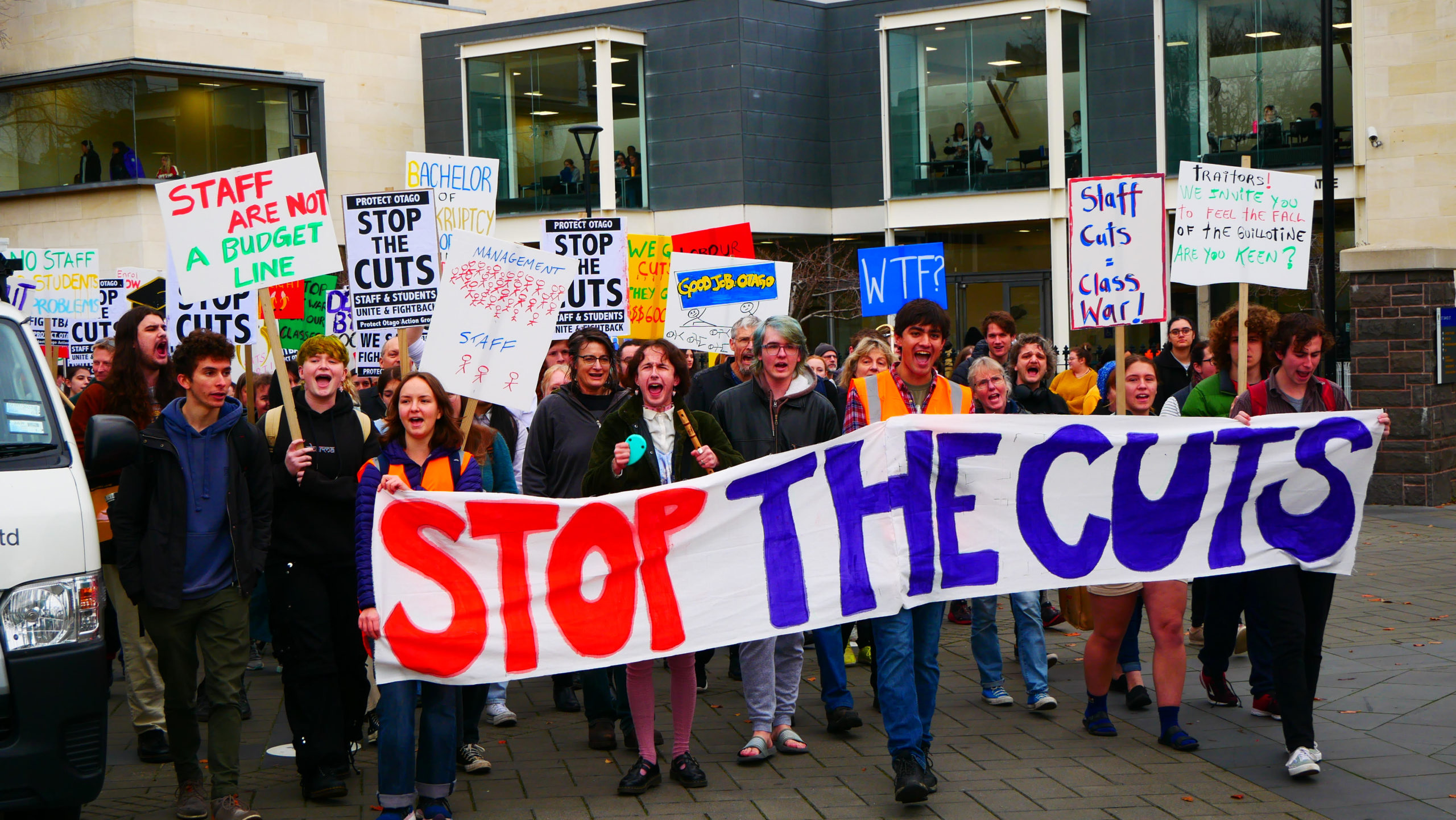
In every major U.S. city, politicians are wringing their hands about the “budget crisis.”
In Seattle, “socialist” mayor Katie Wilson has asked every department to model 5-10 percent budget cuts in order to close a $175 million budget shortfall. Her budget proposal is due in mid-September, and she has made clear that she wants to cut public services, saying “everything is on the table.”
Zohran Mamdani, the DSA-backed mayor of New York City, has asked every department to cut 2.5 percent from their budgets. Mamdani also filed a lawsuit to block $10,000 bonuses for paraprofessionals, or teachers’ aides. He apparently wants to save a penny by screwing some of the lowest-paid workers in public schools.
In Minneapolis and St. Paul, the twin Democratic Party mayors are proposing historic hikes to property taxes, while threatening layoffs of city workers.
This is the story everywhere. A report from last August revealed that at least 20 of the country’s 25 most populous cities would be facing “budget gaps” in 2026. And across the board, capitalist politicians want workers to pay for it.
Where Did All the Money Go?
American cities control enormous budgets. Seattle’s annual budget is about $9 billion. New York City’s is $124 billion. If NYC were a country, its public spending would rank 39th, just above Greece.
The U.S. government actually spends more per person than Switzerland, Austria, Finland, and Sweden. It ranks fifth globally in per capita government spending, just behind Denmark.
So why don’t we have free public healthcare, childcare, transit, and college? Where does the money go?
A lot of it goes to the police. In 2021, U.S. cities spent $135 billion on the police. In the last 5 years, that number has risen dramatically, likely crossing $150 billion (because no — the Democrats didn’t defund the police).
In Seattle, the police budget has gone up by $123 million since the George Floyd movement, to nearly half a billion dollars a year. In Indianapolis, it has gone up $136 million in the same period. In NYC, it has increased by $1.4 billion to a total of $6.7 billion, which is roughly the official budget of the Iranian military.
City money also goes to fund a legion of highly-paid city bureaucrats. The City of Seattle employs around 14,000 people. Among those, over 700 are executives and upper managers, who collectively make at least $140 million a year, with an average salary of $200,000. The city also employs nearly 1,000 “Strategic Advisors” who do things like “leverage data for insights” and "advance resilient communities through strategy." These 1,000 “strategists” make more than $150 million a year, with an average salary of about $160,000. But apparently, these strategic advisors don’t provide enough strategic advice, so the city spends another $40 million or more a year on outside consultants.
So $1 billion a year in Seattle goes to the police, city executives, strategic advisors, and consultants. Yet the Democrats can’t find $175 million without cutting public services. The picture is similar in cities around the country.
The Fish Rots from the Head
The budget crisis in U.S. cities can’t be separated from the crisis at the top of the country’s institutions.
Donald Trump and the Republicans have slashed social programs, including Medicaid, SNAP, and housing programs. Elon Musk took a sledgehammer to government programs through his DOGE agency, while leaving the core institutions of U.S. capitalism — the military, ICE, and the police — completely untouched.
But it’s not just the Republicans. The Democratic Party kicked off the era of austerity after the 2008 financial crisis. In 2012, Barack Obama bragged about slashing $2 trillion from public programs, while military spending swallowed up 20 percent of the federal budget (in 2025, under Trump, it was 14 percent). Obama cut $1.5 billion from heating assistance for low-income families through the LIHEAP program and carried out rent increases in public housing. He slashed billions from federal housing assistance, $400 million from Head Start preschool programs, and $800 million from special education through his disastrous “Sequester” ploy in 2013.
Democrats in cities followed Obama’s lead — for example, Chicago Mayor Rahm Emmanuel abruptly shut down 50 public schools in 2013, in the largest school closure in U.S. history.
The 2008 financial crisis marked a dramatic shift in the policy of the U.S. ruling class. Squeezed by a crisis of profitability and increasingly threatened by the rise of China, they needed to turn the state towards protecting its core interests: military build-up to counter China and Russia, investment in strategic industries like semiconductors, and massive injections of capital to prop up the banks and the teetering capitalist economy. Things like food assistance, affordable housing, and government unions went by the wayside.
Trump is now proposing a $1.5 trillion military budget for 2027 — a 50 percent increase from current levels, and a record-setting 22 percent of government expenditure. He is proposing another $118 billion for the Department of Homeland Security, including over $10 billion specifically for ICE.
The attacks on public services — housing, education, healthcare — are inseparable from the growing appetite of the U.S. military, police, the deportation machine, and other law enforcement agencies. The “budget crisis” facing American cities is really a crisis of capitalism and imperialism, which can only be solved through a revolutionary struggle.
Stop the Cuts
In Seattle, United Front for a Workers’ Party has launched a campaign against the Democrats’ budget cuts. We are demanding:
- No layoffs of workers
- No school closures
- No cuts to public services
- No regressive taxes — no increase to sales taxes, property taxes, sugar tax, or gas tax
There are a dozen ways the Democrats could solve this “crisis” and find $175 million. They could cover the entire budget deficit just by cutting the police budget back to 2017 levels. They could lower the $117,000 starting salary for police, which is nearly twice as high as in New York City. They could lay off part of the army of city executives and “strategic advisors,” or cut their budget for corporate consultants. Councilmembers could save half a million just by cutting their own $140,000 salaries down to the average wage of a worker in Seattle (of course, they’ll never do that).
If the Democrats can’t bring themselves to cut the police budget or trim the sprawling executive bureaucracy, they could increase the Amazon Tax — a tax on big business that workers won in 2020, under the pressure of the George Floyd movement. A small increase in that tax, from an average of 1.7 percent to 2.5 percent on the biggest companies, would also cover the entire $175 million deficit.
But the Democrats don’t want to tax big business. In fact, Democrat Bob Kettle has proposed a reduction of the Amazon Tax.
As we fight to stop the cuts, we need to relentlessly expose the role of the Democratic Party, including “progressive” Democrats like Alexis Mercedes-Rinck and Eddie Lin, who are the AOCs and Elizabeth Warrens of the Seattle City Council. They put on a progressive face, but they ultimately provide cover for the Democratic Party establishment. One way they do this is by refusing to introduce popular legislation (like an increase in the Amazon Tax) which would force the other Democrats to pick a side.
The only thing that can force the Democrats to back off their planned cuts is the mobilization of the working class. United Front for a Workers’ Party is aiming to collect 1,000 signatures by September 24, the day of the first budget hearing. We will mobilize to City Hall on September 24 at 9:30 a.m. to present those signatures and make our demands.
Fight for a Workers’ Budget
Every victory or defeat for workers is determined by the balance of class forces. How strong are the capitalists and their parties? And how strong are we?
When workers go on strike, the strike’s outcome is determined by the level of involvement from the workers, by the union’s ability to disrupt the company’s profits, by the militancy of the workers, by their determination, by the level of support from other unions and organizations, by the size of the union’s strike fund, etc.
Likewise, whether we can stop the cuts to public services will be determined by our level of organization, our determination, our ability to expose the Democratic Party, and our ability to bring organizations like the Democratic Socialists of America, the unions, the smaller left organizations, and the broader mass of workers into the fight.
But just stopping the bleeding isn’t enough. We need to fight for a workers’ budget. We need a budget that meets the basic needs of every worker. We need free public childcare, free public healthcare, free mass transit, affordable public housing, and a jobs guarantee. We need to defund and disarm the police, and invest in safe and stable communities.
If we want to take even one step towards a budget that reflects the priorities of workers, we need to build a party of our own.
The opportunist leadership of DSA and the unions tries to obscure this fact. They have hitched themselves to the Democratic Party, and they make every excuse for why they can’t break from the Democratic Party just yet. But until we do, we will be stuck in this cycle of attacks, with no organization to defend ourselves — like fighting in the workplace without a union and begging the boss for a raise.